America – Cradle For The Second Coming Of The
Christ
CHAPTER VI
THE CIVIL WAR - THE WAR BETWEEN THE
STATES
 One of
the saddest moments in the history of the United States Congress is described
by Saul Pett as follows: One of
the saddest moments in the history of the United States Congress is described
by Saul Pett as follows:
Civil war awaited them and they were leaving now, one
by one, in sad succession.
On Jan. 10, 1861, the gaunt, courtly senator
from Mississippi rose from his desk in the 36th Congress to say goodbye. He
pleaded for peace between North and South. If not...
"Then Mississippi's gallant sons will stand like a wall
of fire around their state," said Jefferson Davis, "and I go hence, not in
hostility to you, but in love and allegiance to her."
Davis became president of the Confederate States of
America a month later. A few months after that, when Union troops were
quartered in the Capitol, when soldiers slept in both chambers and Army cooks
cooked bacon and biscuits in the basement, a young trooper from the Sixth
Massachusetts angrily rammed his bayonet into Davis' desk.
Today, that desk can be found along the center aisle of
the third row up from the well of the Senate. The hole left by the bayonet has
been mended, but the scar remains. From Saul Pett's Associated Press
article.
What led a proud and hopeful nation to this tragic impasse?
After the Revolutionary War, America had enjoyed over seventy years of success
and prosperity. But as we grew, we as a nation became selfish. We forgot the
God that had blessed us. We turned to material prosperity and away from
God.
Perhaps the most obvious symptom of this selfishness was the
eagerness with which this nation embraced slavery. We turned our backs on the
Founders' statement that "Allare created equal," and forgot Patrick Henry's
fiery pronouncement, "Give me liberty or give me death!" Ignoring Jesus'
admonition to do unto others as we would have them do unto us, we built
prosperity on the backs of widows and orphans torn from their homelands, whose
only hope of release was death.
Abraham Lincoln's Addresses
Between the time Abraham Lincoln was elected and
inaugurated, seven states had seceded over this issue. In his inaugural
address, President Lincoln urged all the states to settle their differences
peacefully. Nevertheless, the country found itself divided by war. In 1863, in
the midst of this war, Lincoln issued a proclamation to all Americans,
appealing to them to recognize the true cause of the national calamity:
And inasmuch as we know that, by His divine law,
nations like individuals are subjected to punishment and chastisement in this
world, may we not justly fear that the awful calamity of civil war,
which now desolates the land, may be but a punishment inflicted upon us for our
presumptuous sins to the needful end of our national reformation as a whole
people?
We have been the recipients of the choicest bounties of
heaven. We have been preserved these many years in peace and prosperity. We
have grown in numbers, wealth, and power as no other nation has ever grown. But
we have forgotten God. We have forgotten the gracious Hand that preserved us in
peace and multiplied and enriched, and strengthened us.... We have becometoo
proud to pray to the God that made us. (The Collected Works of Abraham
Lincoln, Vol. 6, pp. 155156, Roy P. Basler)
Through all the horror of the Civil War Lincoln's faith and
humanity never faltered. His Second Inaugural Address expresses his
immortal good will to all:
With malice toward none; with charity for all; with
firmness in the right, as God gives us to see the right, let us strive on to
finish the work we are in; to bind up the nation's wounds; to care for him who
shall have borne the battle, and for his widow, and his orphanto do all which
may achieve and cherish a just, and lasting peace, among ourselves, and with
all nations.
President Lincoln was able to lead this
divided, troubled nation because he himself was so free of pride, so full of
compassion and so mindful of God. We know from biographies that he humbly
turned to God in prayer continually, not only before making an important
decision.
All the world's saviors have in one way or another
loved their enemies and done them good. President Lincoln
was no exception. Few public figures have attained Abraham Lincoln's
magnanimous spirit, although he was vilified as no other American president.
Publicly denounced by Edwin Stanton as a "low cunning clownthe original
gorilla," Lincoln nevertheless appointed Stanton Secretary of War because he
saw him as the best man for the post. When a friend told Lincoln that Stanton
(then a Cabinet member) called President Lincoln "a fool," Lincoln replied:
"Did he call me that? Well, I reckon it must be true then, for Stanton is
usually right." Later, a repentant Stanton sobbed uncontrollably at Lincoln's
bedside after the President's assassination.
Lincoln's selfforgetfulness, his purity of thought and
motive, his affection for his fellow man, his trust in good, were constant
prayers. So wellknown to his countrymen was Lincoln's habit of prayer that
several farfamed statues erected in his honor show him kneeling in supplication
to an allmerciful God.
The Battle of Gettysburg
One of the great turning points in the Civil War came at the
Battle of Gettysburg. The Union cause trembled in the balance as the North
steadily lost ground. General Sickles, a man of great courage who lost a leg at
Gettysburg, later asked Lincoln, "Were you not alarmed during the Battle of
Gettysburg?"
"No, not one moment's anxiety," Lincoln responded. He had
gone to his room, closed the door, fallen on his knees and told the Lord that
the burden of carrying on the cause, in which he so firmly believed, was
greater than he could bear. If the great Union cause was to succeed, omnipotent
power must guide and direct it.
Lincoln recalled that when he finished his confession of
man's limitation and established his faith in the power of Omnipotence, there
came within his soul a peaceful assurance that all was well. Although news kept
coming from Gettysburg of one Southern advance after another and the weakening
of the Northern forces, he had no fear, for God, infinite good, had spoken to
him as clearly as it had to Abraham, Moses and Jacob.
Humble Are the Truly Great
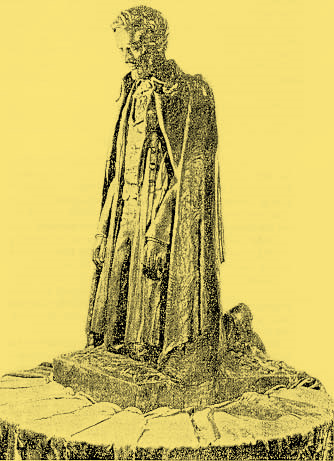
THE KNEELING LINCOLN
Statue in Bronze
Designed by Herbert Spencer Houck.
Lincoln's habitual fervent prayer availed.
God's plan for America to become the cradle for the second coming of the
Christ could not be thwarted. As the hymn assures:
O blest is he to whom is given
The instinct that can tell
That God is on the field
Although he seems invisible.
General McClellan's Vision
It was important that the Union be preserved. If the Union
were destroyed there would be no place on this earth where the prophesied
"Comforter," the second coming of the Christ, could survive. Since "the divine
must overcome the human at every point" (S&H 43:27) it was crucial that
this divine understanding be founded in human consciousness.
Therefore, while God, infinite Mind, was "graciously
preparing" Mary Baker Eddy for the reception of the final revelation of the
absolute divine Principle of scientific mental healing (see S&H 107:4),
Mind was also preparing a place for the second coming of the Christ, the
"Comforter," Science and Health.
The following reportshowing divine intervention to preserve
the Unionis taken from The Individual Christian Scientist, Vol. XI,
No. 2. It was originally published in the Portland (Maine) Evening
Courier on March 8, 1862, a little less than a year after the
Civil War began with the firing upon Fort Sumter by rebel forces in April
of 1861:
When 1862 dawnedfew realized how dire the situation was
for the Republic....General George Brinton McClellan went to Washington, D.C.,
to take over command of the United States Army. At 2 A.M. on the third night
after his arrival, he was working over his maps and studying the reports of the
scouts when a feeling of intense weariness caused him to lean his head on his
folded arms on the table where he fell asleep.
About ten minutes later the locked door was suddenly
thrown open, someone strode right up to him and in a voice of power and
authority said: "General McClellan, do you sleep at your post? Rouse you, or
ere it can be prevented, the foe will be in Washington."
In his published article General McClellan described
his strange feelings.... He seemed suspended in infinite space and the voice
came from a hollow distance all about him....The furnishings and walls of the
room had vanished leaving only the table covered with maps before him. But he
found himself gazing upon a living map of America including the entire
area from the Mississippi River to the Atlantic Ocean.
McClellan was aware of the being that stood beside him,
but could only identify it as a vapor having the vague outline of a
man.
As he looked at the living map the general was at first
amazed and then elated as he saw the troop movements and a complete pattern of
the enemy's lines and distribution of forces. This knowledge would enable him
to terminate the war speedily. But this elation dissolved as he saw the enemy
occupy positions he had intended occupying within the next few days. He
realized his plans were known to the enemy.
At this realization the voice spoke again: "General
McClellan, you have been betrayed! And had not God willed otherwise, ere the
sun of tomorrow had set, the Confederate flag would have waved above the
Capitol and your own grave. But note what you see. Your time is short."
McClellan did note what he saw on the living map,
transferring it to the paper map on his table. When this was done he became
aware that the figure near him had increased in light and glory until it shone
as the noonday sun. He raised his eyes and looked into the face of George
Washington.
With sublime and gentle dignity Washington said,
"General McClellan, while yet in the flesh I beheld the birth of the American
Republic. It was indeed a hard [struggle] but God's blessing was upon the
nation, and...with His mighty hand brought her out triumphantly. A century has
not passed since then....and now by reason of this prosperity she has been
brought to her second great struggle....
"But her mission will not then be finished; for ere
another century shall have gone by, the oppressors of the whole world
[the antiChrist]...shall join themselves together and raise up their hands
against her. But if she still be found worthy of her high calling, [the enemy]
shall surely be discomfited. [Then shall the 'very small and feeble remnant'
prevail 'and shall again take root downward, and bear fruit upward' (Isaiah
16:14 and 37:31)].
"Then [in the 21st century] will be ended her third
and last great struggle for existence.
Thenceforth shall the Republic [after the scripturally
prophesied struggle with the antiChrist has been won (see Rev. chapters 1320)]
go on, increasing in power and goodness, until her borders shall end only in
the remotest corners of the earth, and the whole earth shall, beneath her
sheltering wing [through the message of the second coming of the Christ],
become a universal Republic. Let her in her prosperity, however, remember the
Lord her God, let her trust be always in Him, and she shall never be
confounded."
Washington raised his hand over McClellan's head in
blessing, a peal of thunder rumbled through space; the general awoke with a
start. He was in his room with his maps spread out on the table before him, but
as he looked at them[to his astonishment, he saw] the maps were covered with
marks and figures he had made during the vision....this convinced him that his
dream or vision was real and was from above. [The kingdom of God within
McClellan's own consciousness had revealed to him what he needed to
know.]
He set about immediately...to thwart the enemy's plan,
riding his horse from camp to camp to implement the changes at once. The
Confederate Army was so near that President Lincoln could hear the rumble of
their artillery...at the White House [which no doubt helped to keep him in a
constant state of fervent prayer for the safety of the Union. That prayer
availed].
McClellan's action saved the capitol early in 1862, and
saved the Republic from the second peril. The first "peril" had been the
Revolutionary War.
"Liberty and Justice for All"
On Jan. 1, 1863, Lincolnby virtue of his powers as commander
in chief of the armyissued the Emancipation Proclamation. It was chiefly
a declaration of aims and policy. Much effective legislation followed. Later
the 13th Amendment of the Constitution made slavery in the United States
illegal.
The abolition of slavery was a great stride forward in this
country. It was the spirit of love prevailing. Abolition came about because
enough people cared for their brother man to want him to be free. To stand idly
by and not follow the dictates of love would be an omission of the duty which
God has placed on the shoulders of all who live in His presencethe presence of
Love.
In a day when it was still unusual for women to take an
active role in furthering social justice, Mary Baker Eddy's patriotic articles
and poems in defense of the Union were published in the news media of that day.
Other women also made wonderful contributions. Harriet Beecher Stowe's Uncle
Tom's Cabin and Julia Ward Howe's "The Battle Hymn of the Republic" both
had an enormous influence in crystallizing public opinion in opposition to
slavery.
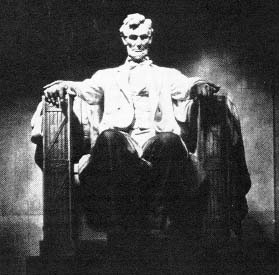
The Lincoln Memorial
Inscribed for posterity in the majestic Lincoln
Memorial is Lincoln's famous Gettysburg Address, calling on Americans to strive
"that this nation, under God, shall have a new birth of freedomthat government
of the people, by the people, for the people, shall not
perish from the earth."
Mrs. Eddy, in her sixteenth to fiftieth editions of Science
and Health, headed her chapter "Animal Magnetism" with Julia Ward Howe's
stirring lines:
He has sounded forth the trumpet
that shall never call retreat;
He is sifting out the hearts of men
before His judgment seat;
Oh be swift, my Soul, to answer Him,
be jubilant my feet.
In joining the effort to preserve the Union and extend our
nation's guarantees of liberty and human rights to "the least of these," Mary
Baker Eddy, then Mary Patterson, was also actively preparing the cradle for the
second coming of the Christ.
Significantly, it was not until after the
Civil War was won and the fruits of liberty were extended to all,
that Mary Baker Eddy was inspired to explain Jesus' teaching that the kingdom
of God is at hand, is within our individual infinite spiritual
consciousness.
Slavery's Abolition Clears the Way
Once the union of the United States of America was
established on a firm foundation as an accomplished fact, and slavery was
abolished, the scene was set and the way was open for the establishing of
Christian Sciencethe discernment of the eternal union of
Principle and its idea as Allinall.
This Principle, which Jesus knew himself to be, expressed
itself for us 2000 years ago as the man Jesus"the highest human corporeal
concept of the divine idea" (S&H 589:16). This Principle, expressing itself
as what is called man and the universe, is currently leading to the recognition
of the equality of the sexes, the annulment of the curse on man, and to
humanity's liberation from all bondage and limitation.
At the end of the Civil War, as Rebel and Union soldiers
bound their wounds and made their weary way home to help a war-battered nation
heal itself, this same Principle was preparing the way for mankind's full and
final healing. Mrs. Eddy writes:
The voice of God in behalf of the African slave was
still echoing in our land, when the voice of the herald of this new crusade
sounded the keynote of universal freedom, asking a fuller acknowledgment
of the rights of man as a son of God, demanding that the fetters of sin,
sickness, and death be stricken from the human mind and that its freedom be
won, not through human warfare...but through Christ's divine Science.
(S&H 226:5)
"The history of our country, like many other histories,
illustrates the might of Mind, and shows human power to be proportionate to the
embodiment of right motives.... To legally abolish slavery in the United States
was good, but its abolition in the human mind is a more difficult task."
(S&H, 16th ed., p. 87)
The United States of America was founded on the promise of
"liberty and justice for all." Forging beyond the Magna Charta and the
Mayflower Compact, it had embedded this guarantee in the Declaration of
Independence, the Constitution, the Bill of Rights, and now in the Emancipation
Proclamation. Its citizens had lived these values and died to uphold them.
Christian Science, which is as ageless as God, made possible
each of these documents and every step forward, for "Where the spirit of the
Lord is, there is liberty." Now the time had come for the full revelation of
Christian Science to human consciousnessthe full revelation that evil is never
real, is never anything but illusion, hypnotic suggestion, that Jesus said
would end with the second coming of the Christ, the "Comforter."
Truth would reveal that human birth and death are hypnotic
suggestions only, which will be overcome as mankind learns the Science of
being, that already and always exists in "the kingdom of God within you."
Remember, in the garden of Gethsemane Jesus prayed "and now, O Father, glorify
thou me with...the glory which I had with thee before [this dream of life in
matter overtook me.]" (John 17:5)
AMERICA book sections
Foreword | I |
II | III |
IV | V |
VI | VII |
VIII | IX |
X | XI |
XII | XIII |
Conclusion | Bibliography |